
It is a fair question, and anyone who answers it with a quick “yes, it’s fine” is not helping you. Lebanon’s appeal is real: its history, food, mountains and hospitality draw people back again and again. But whether Lebanon is safe to visit depends on when you ask, where in the country you plan to go and what your own government advises.
This guide does not try to talk you into a trip. It explains what official advisories currently say, how risk differs across regions, what insurance and flights mean for your decision, and how to judge whether a trip makes sense for you right now. It reflects sources reviewed in autumn 2026, and conditions can change quickly, so check the official pages linked by name below before you act.
What governments are saying about Lebanon right now?
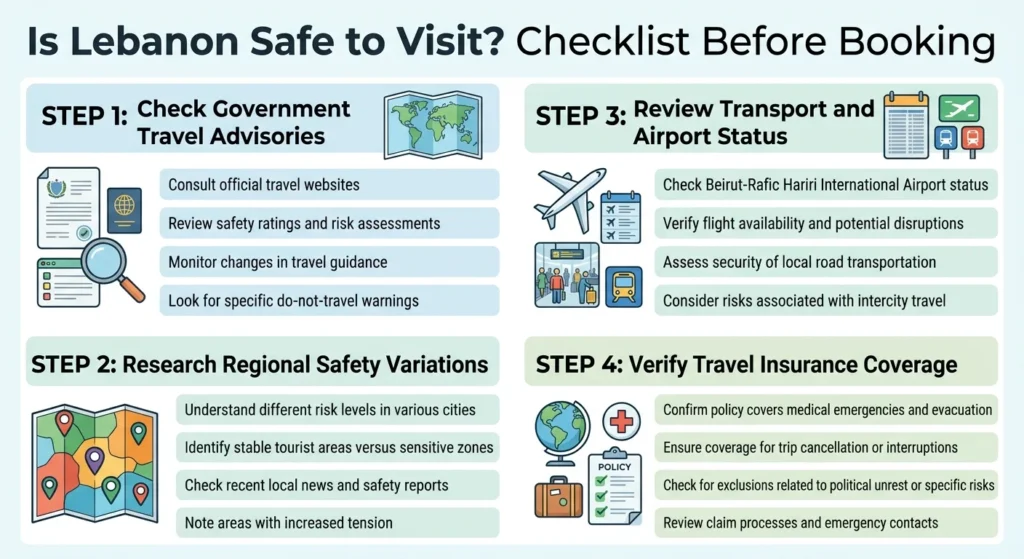
The headline is a cautious one. The United States lists Lebanon at Level 4, “Do not travel”, in an advisory issued on 21 August 2026. The advisory points to risks including crime, terrorism, unrest, kidnapping, landmines and armed conflict. It also notes that landmines and unexploded ordnance exist throughout Lebanon and that US embassy staff face restrictions on personal travel. statestate
Other governments are cautious too. According to one September 2026 summary, Australia and Canada advise against all travel to Lebanon, while the UK advises against all travel or all but essential travel depending on the area. That same summary describes continuing fighting and airstrikes despite a June 2026 framework, particularly in southern Lebanon. wegowego
Advisories are not predictions, and they are written from the perspective of each government’s duty to its own citizens. But they are the most reliable public benchmark available, and they have real consequences for insurance, flights and consular help. If you are choosing whether to book, start here, with the current version of your own government’s page, not a summary from a blog, including this one.
Risk is not the same everywhere
Lebanon is small, yet conditions differ sharply from region to region. The UK advice, for example, restricts travel to southern and eastern regions, Palestinian refugee camps and specified parts of Beirut and Mount Lebanon. The US advisory flags southern Lebanon as an area to avoid for any reason. wego
Two practical points follow. First, any itinerary that includes the south or the border areas deserves a hard look, and in the current climate most governments would say to avoid it. Second, “other regions” does not mean “no risk”. Even where advisories are less severe, they still carry warnings, and situations can change within days. Treat any plan that depends on a calm week as fragile.
Hazards can also be physical rather than political. Unexploded ordnance is a real danger in affected areas, and hiking or off-road exploration away from established routes carries risks that visitors often underestimate.
What it means for travel insurance?
This is the part many travelers miss. Travel insurance may be invalidated if you travel against official advice. If your government advises against travel to Lebanon, read your policy’s terms closely, because cover for medical costs, evacuation or cancellation may be limited or void. wego
Do not assume a policy bought online covers you. Ask the insurer in writing whether it covers a trip to Lebanon under the current advisory, and keep the reply. Our guide to travel insurance for Lebanese travelers explains what to look for in a policy, and our overview of emergency medical travel support shows how assistance works when something goes wrong.
If you cannot get clear cover in writing, that is a reason to pause, not to proceed on hope.
Flights and airspace
Safety is also a logistics question. Aviation regulators have issued conflict-zone bulletins covering Lebanese airspace, and airlines adjust or suspend routes as conditions shift. A trip can be affected before you leave home, or while you are there, if your flight is cancelled and alternatives are limited.
Before booking, check your airline’s current operating status for Beirut, read the cancellation and rebooking terms and keep flexibility in your dates. Avoid non-refundable bookings unless you accept the possibility of losing the money.
Who is traveling matters?
The right answer is different for different people.
A resident or a member of the diaspora visiting family makes decisions with local knowledge, family support and often years of experience in managing day-to-day risk. A first-time foreign visitor has none of that, and governments that tell their citizens to avoid Lebanon are speaking directly to them. A business traveler needs to consider their employer’s duty-of-care rules and insurance. A family with children or elderly relatives has a smaller margin for disruption.
Your answer to “is it safe” should also depend on your tolerance for uncertainty, your ability to leave quickly if needed and whether anyone depends on you.
A practical way to decide
Rather than searching for reassurance, work through a short set of checks.
- Read the current advisory for your nationality and note the date it was issued.
- Confirm your insurance covers Lebanon in writing.
- Check flights and keep refundable or flexible fares.
- Choose your regions with care, and avoid any area your government flags.
- Plan an exit: know how you would leave, who you would call and where your embassy is.
If any of these checks fails, postponing is a legitimate choice. A rescheduled trip is a minor inconvenience, and a trip you should not have taken is not.
How a local planner can help, and what it cannot do?
A local team adds real value in a trip like this. They monitor conditions daily, know which routes and neighbourhoods are accessible, can change drivers, hotels and timing at short notice and speak to people on the ground. That reduces some operational risks and makes a flexible plan possible.
What a local team cannot do is remove the underlying risk or override a government advisory. Be wary of anyone who promises that everything will be fine. A trustworthy planner will tell you when they would postpone a trip, which parts of the country they would avoid and what the plan is if conditions change. That is how Fayad Travel approaches it: we would rather talk you out of a bad date than put you in a difficult position.
If you do decide to travel
If, after weighing the advice, you decide to go, build the trip conservatively. Share your itinerary and contact details with someone at home. Register with your embassy’s traveler program if it offers one. Keep your plans flexible and your accommodation cancellable. Keep cash and documents accessible, and monitor official updates daily.
Review the entry process too. Our guide to Lebanon visa and entry requirements explains what border staff expect, and our pre-travel checklist for Lebanon covers the rest of your preparation. When conditions allow, our guide to the best time to visit Lebanon and our guide for first-time visitors will help you plan the trip itself.
Frequently asked questions
Several governments currently advise against travel to Lebanon or to parts of it, including the United States, which lists it at its highest warning level. Risk differs by region and can change quickly, so read your own government’s current advisory before deciding.
Advisories commonly single out southern Lebanon, border areas, eastern regions and certain refugee camps and districts. Follow the specific guidance from your government, and avoid areas with unexploded ordnance.
Not necessarily. Travel insurance may be invalid if you travel against your government’s advice. Ask the insurer in writing before you book.
It depends on your fare, your hotel’s terms and your insurance. Choose refundable or flexible options where possible, and read the terms before you pay.
Residents and returning family members make their own judgement with local knowledge, but the same practical steps apply: stay informed, keep plans flexible and know how to leave quickly if conditions change.
Talk to us before you decide
If you are weighing a trip to Lebanon, or you want to know how current conditions would affect a specific itinerary, speak to Fly Fayad local team. We will give you a straight view of what we would and would not recommend today, and help you plan flexibly if you go ahead. Speak to our local team about current conditions.
Travel advisories, flight operations and conditions on the ground change quickly. Always check your own government’s current travel advice and confirm cover with your insurer before you book or travel. Last reviewed: autumn 2026.