

Planning a trip that crosses three or four European borders feels exciting right up to the moment you open an application form and it asks a simple question: which embassy are you applying to? Choosing which Schengen country to apply to from Lebanon looks like a small administrative detail. In practice it decides where you book your appointment, which checklist you follow and whether your file is accepted or sent back.
This guide explains the rule consulates use, how it plays out on real itineraries, what happens when your trip is split evenly, and the mistakes that cause trouble. If you have not yet booked a slot, our guide to the Schengen visa appointment in Beirut is the natural next read once you have settled this question.
How the Schengen visa works across several countries?
A Schengen visa is a single permit that allows travel across the Schengen area, so you do not need a separate visa for each country on your route. But you still apply to one country, known as the competent member state. That country examines your application, takes your fee and decides your visa.
This is where multi-country trips get tangled. The visa is shared, yet the application is not. You cannot send the same file to several embassies and take the best answer. You pick one, and the choice must be justified by your itinerary.
For a deeper overview of the process itself, see our Schengen visa guide for Lebanese travelers.
The main destination rule: where to apply from Lebanon
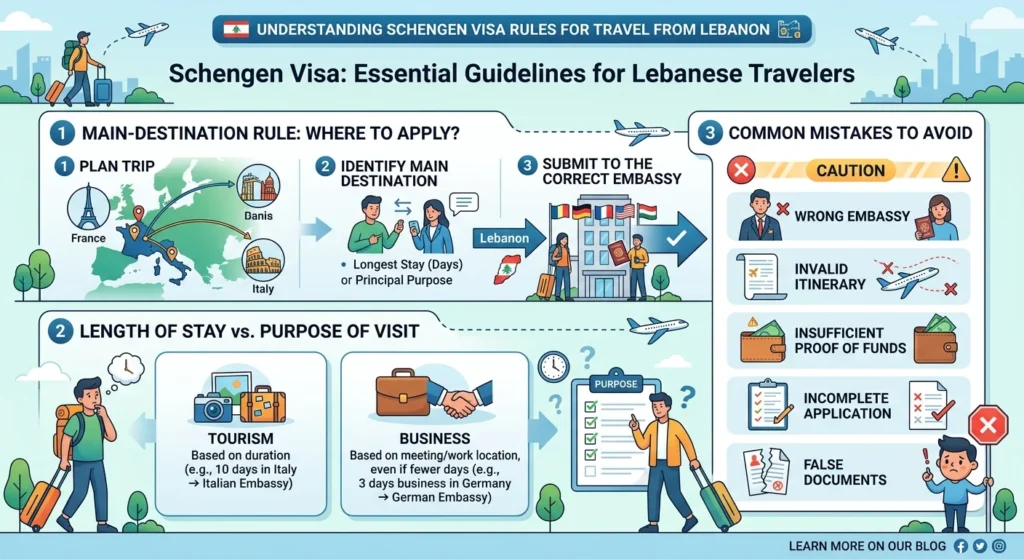
The core principle is straightforward. If you visit several Schengen countries, you apply to the country where you will spend the most nights. That is your main destination.
Count nights, not days, and count only time spent inside the Schengen area. A route that gives you four nights in Italy, three in France and two in Switzerland points to Italy. The fact that you will land in France first, or that Paris feels like the headline of the trip, does not change the count.
A useful habit is to build a simple night-by-night plan before you apply. Write each city, how many nights you will stay and which country it belongs to. Add the totals. The country with the largest total is where you apply. It takes five minutes and prevents an expensive mistake.
What if your nights are split equally?
Sometimes the numbers tie. If you spend, say, four nights in Spain and four nights in Portugal, the rule changes: you apply to the country of first entry into the Schengen area.
Be careful with what counts as entry. If your journey reaches the Schengen area through a connecting airport and you stay in transit without leaving the airport, that is not entry for this purpose. Entry means arriving to begin your stay. Check your actual flight plan rather than assuming.
When nights are unequal, do not try to engineer a tie. The rule exists so that the country most affected by your visit examines your file, and consulates can see when an itinerary has been arranged to fit a preferred embassy.
Examples of how the rule works
Consider a family planning ten days: five in Italy, three in Switzerland and two in Austria. The main destination is Italy, so they apply to the Italian consulate. Their hotels, tickets and documents should clearly show that plan.
Now imagine a couple flying into Paris for two nights before taking a train to Barcelona for six nights and then returning home through Madrid. Spain has the most nights, so Spain receives the application, even though France is the first stop.
Finally, picture a traveler spending four nights in Germany and four in Czechia, entering through Frankfurt. With equal nights, Germany is the country of first entry, so Germany is the place to apply.
These are illustrations, not client cases, but the logic applies to almost every itinerary. If your own route does not fit neatly, ask for guidance rather than choosing the answer you hope is correct.
Countries without a consulate in Lebanon
Not every Schengen state has an embassy or consulate in Beirut. When your main destination does not, it may be represented by another Schengen country, or you may need to apply through a different location or channel, depending on that country’s arrangements.
These representation agreements change, and the details vary. The reliable approach is to check the official website of your destination country’s foreign ministry or its nearest embassy, which will state where Lebanese residents should lodge applications. Do not rely on a forum post or an old article for this, because an outdated answer here can cost you weeks.
If the embassy you need handles applications through an external visa centre, that centre’s page will also tell you which documents it accepts and how appointments are booked.
Which Schengen country is easiest?
Many applicants ask this, and the honest answer is that there is no legitimate shortcut. Refusal rates differ between consulates, and the European Commission publishes visa statistics showing how states perform. But choosing a country with a better record than your itinerary supports is risky, not clever. If your documents say you will spend most of your time in Italy but you apply through another embassy, the mismatch is visible and can lead to a refusal or a return of your file.
The better strategy is to apply to the right country, then make the file as strong as possible. Clear itinerary, consistent bookings, sound finances and a sensible reason for travel carry more weight than any choice of embassy. Our guide on Schengen visa financial proof shows how to present the money side, and our overview of common visa rejection reasons explains where applications usually fail.
If you genuinely have flexibility, for example you can reasonably spend longer in one country, you can design your trip so that the main destination is the one you prefer to deal with. That is different from pretending. The itinerary must be real.
Documents must match the country you choose
Once you decide, every document should reflect that decision. Hotel reservations should cover the nights you have listed. Flight bookings should match your entry and exit points. Your cover letter, if you write one, should describe the same route.
Inconsistency is a quiet cause of trouble. An officer comparing your hotel bookings to your stated main destination will notice if the numbers do not agree. If your plans change before your appointment, update the documents rather than hoping the difference will pass unnoticed.
Do not pay for non-refundable bookings until your visa is approved. A refundable reservation or one you can cancel is usually enough for the application stage, and the embassy’s checklist will say what it expects.
Planning a route that makes the visa simpler
Sometimes the best answer to “which country should I apply to” is to shape the trip so the answer is obvious. A route with a clear main destination, plus short side visits, is easier to document than five equal stops.
For example, a ten-day trip with six nights in Italy and a short stay in a neighbouring country is simple to explain and simple to book. A route that bounces between six countries in ten days is harder to plan, more tiring to enjoy and trickier to justify on paper.
Our guide on multi-country itinerary planning shows how to balance stops, and our guide on the best time to visit Europe can help you decide which season suits the cities on your list. For budgeting, our guide to Europe trip costs helps you size the trip before you commit.
Not every European country is in the Schengen area
One more source of confusion is that Schengen and Europe are not the same thing. Some popular destinations sit outside the Schengen area and have their own rules. The United Kingdom and Ireland, for instance, are not part of it, and the UK runs a separate visa system. If your route includes the UK, our guide to the UK visa from Lebanon covers that process.
If a trip mixes Schengen and non-Schengen countries, treat them as separate requirements. A Schengen visa does not cover them, and you will need to confirm each country’s rules on its own.
Frequently asked questions
Apply to the country where you will spend the most nights. If your nights are equal across two or more countries, apply to the country of first entry into the Schengen area.
No. Your application must go to the country that is your main destination or first entry, according to your itinerary. Choosing an embassy only because it seems easier can lead to a refused or returned application.
Check the official website of that country’s foreign ministry or nearest embassy. It will say whether another Schengen state represents it in Lebanon or whether you must apply elsewhere.
A connection where you remain in the airport transit area generally does not count as entering the Schengen area for this purpose. Check your flight plan and, if you are unsure, ask the embassy or a visa adviser before you apply.
Minor adjustments within your approved dates are usually manageable, but major changes in your main destination or length of stay can create problems at the border. If your plans change substantially, check with the issuing embassy before you travel.
Plan your European route with confidence
The right application starts with the right itinerary. If you are mapping a multi-country trip and want help deciding which Schengen country to apply to from Lebanon, Fly Fayad Travel’s team can help you shape the route, check your documents and prepare your file before you book an appointment. Browse Europe packages or request a custom route, or learn how to book the appointment itself.
Rules on competent member states and representation change. Always confirm current requirements on the official embassy or visa-centre website before you apply.