
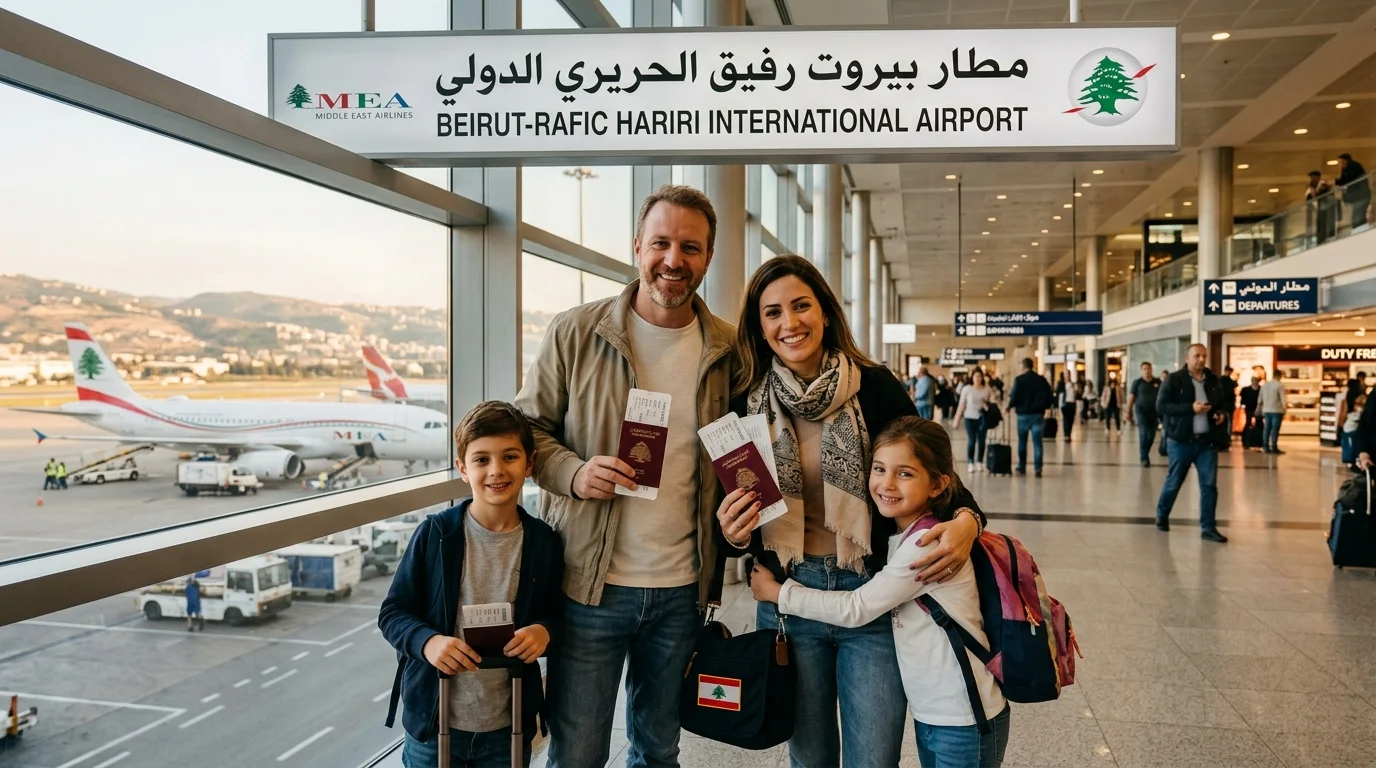
Most parents prepare for a family trip by booking the hotel and packing the snacks. The paperwork for traveling with children from Lebanon often gets less attention, until a check-in agent asks for a document you did not know you needed. A missing consent letter or a mismatched name can end a family holiday at the airport desk.
This guide covers the documents for children traveling from Lebanon: passports, birth records, parental consent, what changes when only one parent travels, and how to prepare for relatives or grandparents taking the children. Rules differ between airlines, destinations and authorities, so treat this as a planning framework and confirm the details for your specific route.
If you are applying for a visa as well, our guide to documents for family Schengen applications covers that part of the process in detail.
Why documents for children get extra scrutiny?
Border and airline staff are trained to watch for situations where a child could be traveling without the knowledge or permission of a parent. That is not a comment on your family. It is a safeguard that applies to everyone, and it is why checks can feel more detailed when a child travels without both parents.
The practical effect is that the question is not only “does this child have a passport?” but also “can this adult show they are entitled to travel with this child?” Answering that question in advance, on paper, makes the airport experience far smoother.
Does every child need their own passport?
In general, yes. Children usually need their own valid passport, and a child cannot normally travel on a parent’s passport. Check the validity period well before you book, since many destinations require the passport to remain valid for several months after your planned return, and airlines may refuse boarding if the rules are not met.
Pay attention to the practical details:
- Passport renewal for a child can take time, so start early rather than weeks before departure.
- Names should match across the passport, flight ticket, visa and any consent letter. Even small spelling differences can cause delays.
- If a child holds more than one nationality, plan which passport to use at each border and keep the details consistent across bookings and documents.
Our guide to documents for international travel gives a wider checklist for all family members.
The birth certificate and proof of relationship
Many officials want to see how the adult and child are related. For parents traveling with their own children, this usually means carrying the child’s birth certificate or an official family civil record that lists the parents’ names. Some travelers also carry a translated copy, since documents in Arabic may need to be understood by staff in the destination country.
When the child’s surname differs from the parent’s, proof matters even more. Parents who have different surnames, or who remarried, should carry documents showing the relationship, such as the birth record and, where relevant, a marriage record or other legal paperwork.
Carry originals and photocopies. Keep them in your hand luggage, not in a checked suitcase.
One parent traveling: the consent letter
This is the situation that causes the most stress. When a child travels with only one parent, some airlines, border authorities or destination countries may ask for a letter showing that the other parent agrees to the trip.
A good parental consent letter typically includes:
- The full names, passport numbers and contact details of both parents.
- The child’s full name, date of birth and passport number.
- The traveling adult’s name and relationship to the child.
- The trip dates, destination and, ideally, the address where the child will stay.
- A signature from the non-traveling parent, and a copy of that parent’s identification.
Some authorities prefer the letter to be notarized or certified, and some want a translation into the destination country’s language or into English. Requirements vary, so check with the airline and the destination country’s embassy or consulate. For travel from Lebanon, you can also ask the relevant Lebanese authorities, such as General Security, about any exit requirements that apply to your family’s situation.
Even where the law does not strictly demand a letter, carrying one is a low-cost safeguard.
A scenario to illustrate
Imagine a mother traveling to Cyprus with her eight-year-old while the father stays in Beirut for work. At check-in, the agent asks whether the father knows about the trip. Because she carries a signed consent letter, a copy of his passport and the child’s birth certificate, the conversation takes thirty seconds. Without those papers, it could take much longer, and might end with a missed flight. This is an illustration rather than a client story, but it captures how the documents work in practice.
Separated, divorced or widowed parents
Family situations vary, and the paperwork changes with them. In Lebanon, custody and personal status matters are handled by the court or religious authority relevant to the family, so the documents you hold may look different from another family’s.
If you share custody, carry the document that confirms your rights over the child, plus the consent letter from the other parent if the trip requires it. If the other parent is deceased, a death certificate can answer questions at the border. If the other parent cannot be reached, or if consent is disputed, speak to a lawyer before you book, because travel plans in that situation need careful handling.
Do not try to improvise. A border officer cannot resolve a family dispute at the counter, and an unclear situation may mean denied boarding.
When grandparents, relatives or friends travel with the child?
Children often travel with a grandparent, an aunt or a family friend. In these cases, the adult needs written authority from both parents, not just one, along with copies of the parents’ IDs and the child’s documents.
The letter should name the accompanying adult, state the trip dates and destination, and include contact details for both parents so officials can reach them if needed. Keep the tone factual. Check whether the airline or destination requires a specific form.
Our guide on multi-generational family trips in Europe explains how to plan a trip where several adults share the responsibility.
Children traveling alone
Some airlines allow older children to fly as unaccompanied minors, with age limits, fees and procedures that differ from one airline to another. Typically a parent completes a form, an adult hands the child to airline staff and another adult is named to collect the child at the destination.
If your child will travel this way, read the airline’s policy carefully before booking and ask what identification the collecting adult must show. Not every route and not every connection is permitted, so confirm everything in advance.
Visas for children
A child who needs a visa usually needs their own application. For the Schengen area, applications are generally submitted per traveler, and many consulates have specific rules for minors, including parental signatures and proof of consent. Children below a certain age are typically exempt from fingerprinting, though you should check the details on your embassy’s page.
If you are booking a slot, read our guide to the Schengen visa appointment in Beirut, and add your children’s documents to the same preparation list. For the financial side of a family file, our guide to Schengen visa financial proof shows how parents’ income and a sponsor’s letter support children’s applications.
Health, insurance and special needs
Documents are not only legal. Bring vaccination records if your destination requires them, and carry a list of any medications your child takes, with prescriptions where relevant. If your child has an allergy or a medical condition, a short note from the doctor can help in an emergency abroad.
Make sure travel insurance covers every family member, including children, and check the age limits and conditions. Our guide to travel insurance for Lebanese travelers explains what to look for.
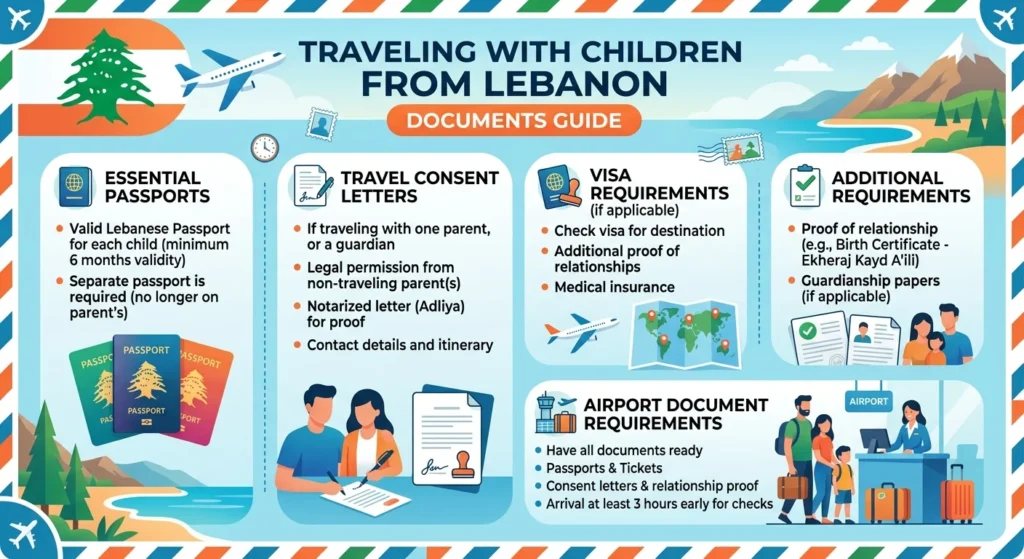
A practical document pack for family trips
Keep a single folder, ideally one printed set and one digital copy stored securely. It should hold passports, visas, birth certificates, consent letters, copies of parents’ IDs, booking confirmations, insurance details and emergency contacts. Add a note of the child’s medical information.
Check names and dates across all of them the night before you travel. Little mismatches are easiest to fix at home.
Frequently asked questions
Requirements depend on the airline, the destination and the authorities involved. Even where it is not mandatory, carrying a signed letter from the other parent, with a copy of their ID, is a sensible safeguard.
Some countries and airlines prefer notarized or certified letters, and some ask for a translation. Check with your airline and the destination country’s embassy, and ask the Lebanese authorities about any exit rules that apply to your family.
Generally no. Children usually need their own passport, with enough validity for the destination’s rules.
A letter signed by both parents, copies of the parents’ IDs, the children’s passports and birth certificates, and any visas or tickets. Include contact details so officials can reach the parents.
Do not travel until you have legal advice. Border officials cannot settle family disputes, and a trip without clear authority can lead to denied boarding or other difficulties.
Plan the whole trip, not just the paperwork
Good documents make a family trip calmer, but they are one piece of a bigger plan. Fly Fayad Travel’s family travel team can help you choose child-friendly destinations, line up bookings that match your paperwork and flag requirements early. Plan a family trip with our team, or read our guide to family-friendly travel packages in the Middle East for ideas.
Rules for minors differ by airline, destination and authority, and they change. Always confirm current requirements with your airline, the destination’s embassy and the relevant Lebanese authorities before you travel.