
Business travel rarely runs on a relaxed schedule. A client in Milan wants a meeting next month, a trade fair in Germany opens in six weeks and the board approved the trip yesterday. For Lebanese executives and company owners, the visa is often the slowest link in that chain, and the Schengen business visa from Lebanon has its own set of documents that differ from a holiday application.
This guide explains what counts as a business trip, which documents consulates usually expect, how invitation letters and company papers work, how timing fits around busy calendars and where applications tend to fail. If you are new to the process, our Schengen visa guide for Lebanese travelers covers the general framework first.
What a Schengen business visa covers?
A Schengen business visa is a short-stay visa issued for business purposes. It allows activities such as attending meetings, negotiating contracts, visiting suppliers or clients, taking part in conferences and trade fairs and exploring business opportunities. It is not a work permit, and it does not allow you to take up employment or provide paid services on the ground in a way that amounts to working in the country.
That boundary matters. If your trip involves installing equipment, delivering training or performing work for a local client, the rules may be different, and you should check with the relevant embassy before you apply. Applying for the wrong category, or describing your trip vaguely, is a common cause of delays.
Business visa vs tourist visa: what changes?
The basics are the same: passport, photographs, travel insurance, accommodation and flight reservations, and evidence of funds. What changes is the story the documents must tell. Instead of a holiday itinerary, the consulate wants to see a clear business purpose, a legitimate host and a company that supports your trip.
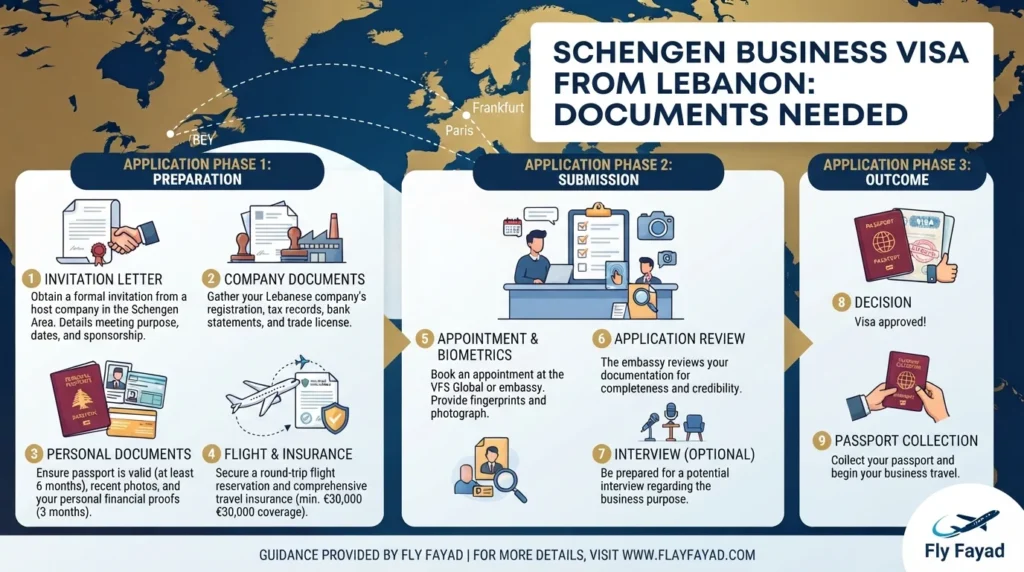
In practice, that means three extra layers: an invitation letter from the host organisation, a letter from your employer or your own company documents, and evidence that the business relationship is real. Everything must agree on dates, purpose and who pays.
The invitation letter: what it should include
The invitation letter is the center of a business file. It comes from the company, organiser or institution you are visiting, and it explains why you are traveling. Consulates generally look for the following details:
- The host’s full name, address, contact details and registration information.
- Your full name, passport number and position.
- The purpose of the visit, such as a meeting, conference or trade fair.
- The exact dates and place of the visit.
- Who will cover travel, accommodation and living costs.
- A signature from an authorised person, ideally on company letterhead.
Vague letters cause trouble. A line such as “business meetings” without any detail invites questions. State what the meeting is about, who you are meeting and why you are the right person to attend. If the invitation relates to a trade fair, attach registration or ticket confirmation and the event details.
Embassies sometimes ask for specific formats or additional forms, so check your destination country’s requirements before the letter is written, not after.
The letter from your own company
The second letter comes from your employer or, if you own the business, from your company. It typically confirms your position, your length of service, the purpose of the trip, the dates and that the company is sponsoring or authorising the travel. It should also confirm that you will return to your role in Lebanon.
Use company letterhead, add a signature and a stamp from an authorised signatory and include contact details so the consulate can verify the company if needed. If you are an owner or a self-employed professional, attach a letter that explains your role and why the trip matters to your business.
Company documents consulates may ask for
To show that your company exists and operates, many consulates ask for supporting papers. Depending on the embassy and your situation, these can include:
- A commercial register extract or equivalent proof of registration.
- Tax or social security documents showing the company is active.
- Recent company bank statements.
- Proof of a prior business relationship with the host, such as contracts, invoices or correspondence.
- A letter from a chamber of commerce or trade association, where the embassy requests one.
Not every embassy asks for all of these, so follow the checklist for your country. Where documents are in Arabic, certified translations may be required. Make sure names, addresses and activities match across all papers, since inconsistencies draw attention.
Personal finances and bank statements
Business trips do not remove the need to show you can cover costs. If your employer pays, include a letter confirming it, alongside the company’s financial evidence. If you pay yourself, personal bank statements are part of the file. In many cases, both are useful.
Consulates look for coherence: a stable income, a believable account history and a trip budget that matches your documents. Our guide to Schengen visa financial proof explains how to present statements and explain large deposits.
Which country should you apply to?
The same rule applies as for any Schengen application: you apply to the country where you will spend the most nights, or the country of first entry if nights are equal. For business trips across several countries, such as a meeting in Paris followed by a trade fair in Frankfurt, count nights carefully and make sure your invitations and bookings support the choice. Our guide to which Schengen country to apply to from Lebanon walks through the logic.
Timing: applying when your calendar is full
Business trips often arrive on short notice, but visa timelines do not shrink on request. You can generally apply up to six months before travel, and many centres expect applications at least fifteen days beforehand, with processing times that can extend longer. Appointment availability adds another variable. Our guide to the Schengen visa appointment in Beirut explains booking, and our guide to Schengen visa processing time from Lebanon explains how long decisions can take.
If you travel regularly, plan ahead. Keep copies of invitation templates, standard company letters and recent statements ready so you can assemble a file quickly when a trip appears. Avoid non-refundable flights and hotels until the visa is approved.
Multiple-entry visas for frequent travelers
Executives who travel to Europe often benefit from a multiple-entry visa. Under Schengen rules, applicants who have previously obtained and lawfully used visas may become eligible for visas with longer validity, such as one year, then two, then up to five, though this depends on your travel history and the consulate’s assessment. A clean record of past trips, used within the dates and conditions of earlier visas, supports the case.
Do not assume you will receive a multiple-entry visa. Explain in your application why you need repeated travel, and be prepared for the consulate to issue a shorter visa. Overstaying or misusing a previous visa can damage future applications.
Traveling with a team
If several employees travel together, prepare a consistent file for each person while keeping the company’s documents aligned. Each applicant needs their own application, passport and documents, with an invitation that names them. Use the same format across the group, but do not copy and paste details that differ, such as positions or travel dates.
For group logistics, coordinate bookings so everyone’s dates and hotels match the invitation. Our guides on corporate travel policy and multi-city business trip planning explain how to keep team travel organised.
Common reasons business visa applications fail
Unclear purpose. A vague invitation or a trip that looks like work rather than a visit raises questions.
Mismatched details. Dates, titles or company names that differ between documents suggest carelessness.
Weak proof of the company. If the consulate cannot see that your business exists and operates, the application loses credibility.
Insufficient funds or unclear payment. It must be obvious who is paying and that the money exists.
Last-minute applications. Tight timing leaves no room to fix a missing document.
Our guide to common visa rejection reasons explains how officers read files and what to do if an application is refused.
Insurance and practical arrangements
Travel medical insurance covering the whole stay is typically required, with a minimum coverage level set by Schengen rules. Keep your policy documents with your application and carry a copy on the trip. For corporate travelers, it is worth checking that your company’s policy meets the visa requirement, since some business policies do not.
On the practical side, keep digital copies of all documents, carry the invitation letter when you travel and bring business cards and meeting details in case border officers ask about the purpose of your visit.
Frequently asked questions
In most cases, yes. A signed invitation from the host company or organiser, with details of the visit, is a core document. Check the embassy’s checklist for any required format.
Generally yes, since attending trade fairs and exhibitions is a standard business purpose. Include registration or ticket confirmation and a clear explanation of your role.
No. A business visa allows meetings, negotiations and similar activities, but not employment or paid work. If your trip involves delivering services, check the rules with the embassy first.
You can apply up to six months before travel and should leave as much margin as possible. Appointment availability and processing times vary, so avoid waiting until the last weeks.
Possibly, especially if you have a record of earlier visas used correctly. The decision rests with the consulate, so explain your travel needs clearly and do not assume approval.
Get your business visa file ready before the trip is urgent
A strong business file is a set of documents that fit together: a clear invitation, a supportive company letter, solid finances and a sensible timeline. If your team travels regularly or you want help preparing a file for an upcoming trip, Fly Fayad corporate travel desk can review your documents, align them with the embassy’s requirements and coordinate flights and hotels around your approval. Talk to our corporate travel desk, or see how we handle corporate incentive trip planning.