

Japan is a country that humbles the overconfident planner. The trains are precise, the cities are enormous and every neighbourhood seems to hold three reasons to stay longer. Ten days sounds generous until you start listing what you want to see, and that is exactly why a good Japan 10-day itinerary matters. The right route turns a rushed checklist into a trip with room to breathe.
This guide lays out a classic first-time route through Tokyo, Kyoto and Osaka, with Nara and an optional Mount Fuji area stop. It covers pacing, transport, where to base yourself, food, seasons and the practical details that Lebanese travelers often ask about, from the long flight to halal dining. If you are still deciding when to go, our guide to cherry blossom travel and spring destinations explains why spring is so popular.
How to plan a 10-day trip to Japan?
Ten days gives you enough time for the big three cities without turning every day into a sprint. The logic is simple: spend roughly four nights in Tokyo, three or four in Kyoto and two in Osaka, then use day trips to add variety. Fewer bases means fewer hotel changes, and hotel changes are where time disappears.
Why this route works for first-timers?
Tokyo, Kyoto and Osaka sit along Japan’s main high-speed rail corridor, so moving between them is quick and comfortable. You get modern energy in Tokyo, temples and traditional streets in Kyoto and a food-obsessed city in Osaka, with Nara close enough for an easy half day. It is the route most visitors take for a reason, and it leaves room to adapt to your interests.
The big decision: pace
Many first-timers try to add Hiroshima, Kanazawa and the Japanese Alps. Resist the urge. Ten days is better spent seeing fewer places well. If you want a faster trip, add one extra stop. If you prefer a calm one, drop the Mount Fuji area and stay longer in Kyoto.
Before you go: visa, flights and timing
Visa for Lebanese travelers
Lebanese passport holders need a visa to visit Japan, and the application takes planning, including a day-by-day itinerary. Our guide to the Japan visa for Lebanese citizens explains the process and documents. Start well before you buy non-refundable tickets, and use the itinerary below as a base for the plan the embassy asks for.
Flights from Beirut
There is usually no direct flight from Beirut to Japan, so expect a connection through a hub in the Gulf, Turkey or elsewhere. Total journey time is long, often well over half a day, so plan your first day lightly. Check routes and schedules for your dates, since airlines change them.
When to go?
Late March to early April brings cherry blossoms, and November is known for autumn colour. Both are beautiful and busy, with hotels selling out early. Summer is hot and humid, and winter is cold but quieter, with clear skies in Tokyo. Book well ahead for blossom season, and keep dates flexible if you can, since bloom timing shifts from year to year.
Days 1 to 4: Tokyo
Tokyo is less a city than a collection of cities, each with its own character. Base yourself near a major station, such as in Shinjuku, Shibuya or Tokyo Station, so you can reach everything by train.
Day 1: arrive and ease in
After a long flight, keep the first day simple. Check in, walk the neighbourhood, eat something local and sleep early. Jet lag is real, since Japan is six to seven hours ahead of Lebanon depending on the time of year. A light first evening makes the next day much better.
Day 2: traditional Tokyo
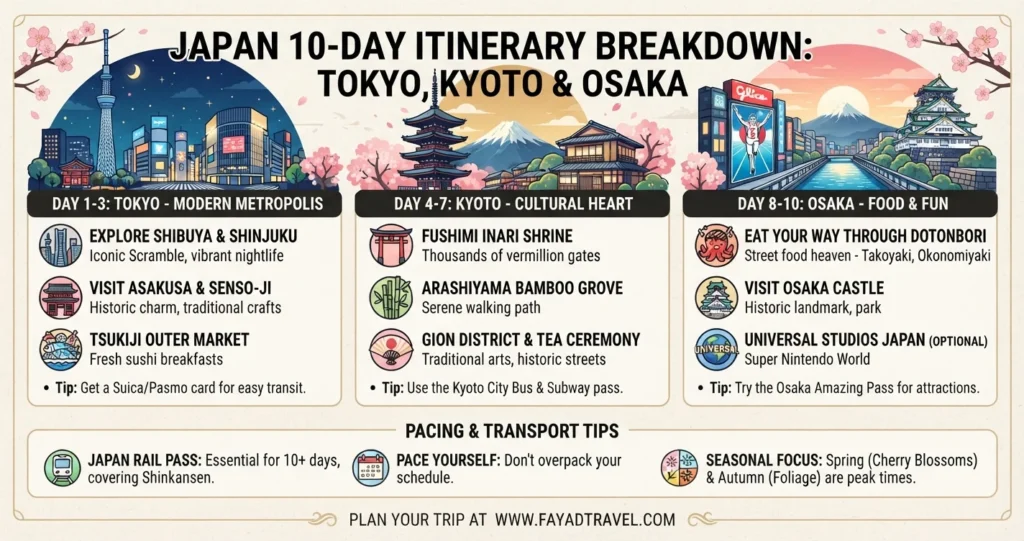
Start at Senso-ji in Asakusa, Tokyo’s oldest temple, and wander the market street leading to it. Go early to avoid crowds. Afterwards, visit the leafy grounds of Meiji Shrine and walk through Harajuku, then finish in Shibuya for the famous crossing at dusk.
Day 3: modern Tokyo and food
Spend the morning at the outer market area for breakfast, then explore Ginza and Akihabara for shopping and electronics. In the evening, head to Shinjuku, where neon streets and tiny restaurants create the scene most people picture. If you enjoy immersive digital art, book an exhibition ahead of time, since tickets can sell out.
Day 4: a day trip from Tokyo
Choose one: Nikko for shrines and mountain scenery, Kamakura for temples and a coastal feel, or Hakone for hot springs and views of Mount Fuji on a clear day. Hakone works well if you want to stay one night in a traditional inn with an onsen, and then continue to Kyoto the next morning. Check the weather, since Fuji is often hidden by cloud.
Days 5 to 8: Kyoto and Nara
Travel from Tokyo to Kyoto by high-speed train, which takes a little over two hours on the fastest services. It is one of the most comfortable journeys in the world and a highlight in itself. Book seats in advance in busy seasons, and if you have large luggage, check the rules for oversized bags.
Day 5: arrive in Kyoto and explore Gion
Drop your bags, then explore the historic Gion district in the late afternoon. Wooden townhouses, tea houses and narrow lanes show a more traditional Japan. Be respectful when you photograph people, and avoid blocking narrow streets.
Day 6: temples and shrines
Begin early at Fushimi Inari, with its thousands of red torii gates climbing the hillside, before the crowds arrive. Then visit Kiyomizu-dera and wander the old streets below it. Finish with Kinkaku-ji, the golden pavilion, if energy allows.
Day 7: Arashiyama and a slower pace
Head to Arashiyama for the bamboo grove, riverside paths and temple gardens. Mornings are quieter. This is a good day to try a tea ceremony or a kaiseki-style meal, and to rest in the afternoon.
Day 8: Nara day trip
Nara is close to Kyoto and Osaka, and its parks, large temples and free-roaming deer make for an easy, charming day. Visit Todai-ji, home to a giant bronze Buddha, and walk the park. Then continue to Osaka in the evening, or return to Kyoto if you prefer a calmer finish.
Days 9 and 10: Osaka and departure
Osaka has a different personality from Kyoto: louder, funnier and obsessed with food. If Kyoto is the poet, Osaka is the comedian. It is also a practical departure point, since the main international airport is close.
Day 9: Osaka’s food and castle
Visit Osaka Castle in the morning, then spend the afternoon and evening in Dotonbori, the neon-lit canal district, trying local street food. Be adventurous but check ingredients, especially if you follow dietary rules.
Day 10: last-minute shopping and flight home
Use your final morning for shopping or a last coffee, and leave plenty of time for the airport, since arrival times for international flights are long. Many travelers use luggage forwarding services to send suitcases ahead, which makes train rides lighter. Ask your hotel how it works.
Getting around Japan: trains, passes and cards
High-speed trains and rail passes
Japan’s rail network is excellent, but nationwide rail passes have become less of a bargain for many itineraries after fare changes in recent years. For a route like this one, compare the cost of individual tickets with any pass before you buy. Reserve seats for the main high-speed legs in busy periods.
Transit cards and phones
Prepaid transit cards, available as physical cards or on some phones, work on trains, subways, buses and in many shops, saving you from buying a ticket each time. Pair them with a local eSIM or pocket Wi-Fi so you can use maps and translation apps, which are very helpful.
Food in Japan for Lebanese travelers
Food is a reason to go, but dietary needs deserve planning. Pork and alcohol appear in many dishes, including broths, sauces and seasonings, and labels can be hard to read. Halal and vegetarian-friendly restaurants exist in the major cities, and seafood and vegetable dishes are widely available, but they are less common than in the Middle East. Research options in advance, use translation tools to explain what you can and cannot eat and carry snacks for days when choices are limited.
Budget and comfort: how to plan spending
Japan can fit many budgets, from simple business hotels to luxurious inns. Flights and accommodation are usually the largest costs, and prices rise in blossom season. Mix a few special stays, such as a traditional inn with a hot-spring bath, with simpler hotels in between. Our guide to luxury travel vs budget travel explains where extra spending pays off.
Practical tips for your first trip to Japan
Etiquette and customs
Be quiet on public transport, queue patiently, avoid tipping and take off your shoes where asked. Carry some cash, since smaller places still prefer it. Check customs rules for medication before you travel, because some common medicines are restricted.
Insurance and health
Healthcare is excellent but can be costly for visitors, so take travel insurance that covers medical treatment. Our guide to travel insurance for visa applications explains what to look for.
Packing and luggage for a multi-city route
Pack light, because you will carry bags up station stairs and through crowded platforms. Comfortable walking shoes matter more than anything else, since a typical day covers many kilometres. Bring layers for changing weather, a small day bag and a power adapter, and leave room for souvenirs. If you buy a lot, ship a suitcase onward rather than dragging it between cities.
Frequently asked questions about a Japan 10-day itinerary
Yes, for a first visit focused on Tokyo, Kyoto and Osaka. You can add Nara and a day trip without rushing, though you will need to choose rather than see everything.
Late March to early April for cherry blossoms and November for autumn colour are the most popular times. They are also the busiest, so book early.
Yes. Lebanese passport holders need a visa before traveling, and the application usually involves a day-by-day itinerary. Check the embassy’s current requirements.
By high-speed train, which takes a little over two hours on the fastest services. Reserve seats in advance during busy periods.
Yes, with planning. Halal restaurants exist in major cities, but options are more limited than in the Middle East, so research ahead and check ingredients.
Plan your Japan trip with Fly Fayad
A great Japan trip is built on the right pacing, the right hotels and the right timing. Fly Fayad’s team can help you shape a route around your dates, arrange flights and stays and coordinate visa preparation so the trip starts smoothly. Request a tailor-made trip, or explore our Far East packages.